
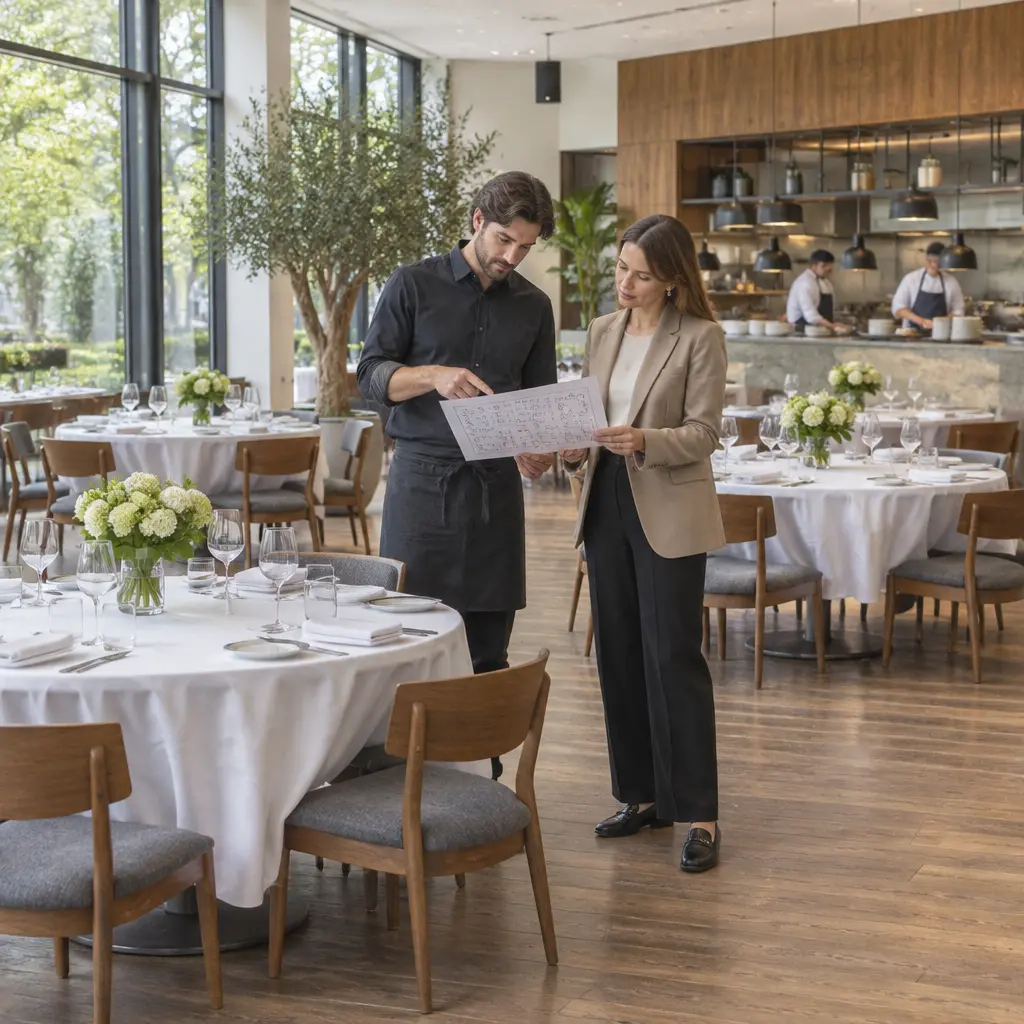
Group dining service flow is the prearranged sequence for ordering, preparing, delivering, and clearing food for a party. Before an event, the organizer and restaurant can agree on menu limits, order deadlines, pacing, dietary accommodations, and service responsibilities to reduce kitchen bottlenecks without making the meal feel rushed. This planning matters because restaurant kitchens must coordinate labor, equipment, ingredients, and ticket timing under fluctuating demand; the U.S. Bureau of Labor Statistics reported that food preparation and serving occupations employed about 12.8 million people in May 2023, underscoring the scale and labor intensity of the sector. A reliable plan combines capacity-aware scheduling, a practical menu, synchronized ordering, clear communication, and contingency measures.
Pre-negotiated service flow as a group dining attribute
Pre-negotiated service flow is an agreement made before a group arrives about how the restaurant will receive orders, sequence kitchen work, serve courses, and handle exceptions. It is an operational arrangement rather than a single formal industry standard: the National Restaurant Association’s foodservice guidance emphasizes planning, safe food handling, and coordinated operations, while restaurant service practices translate those principles into event-specific procedures. Its defining attributes are advance decisions, named points of contact, realistic timing, and a shared understanding of what the kitchen can deliver.
Useful forms of the arrangement include a limited-choice menu, a fixed menu, preorders, staggered seating, a planned course release, and a buffet or family-style format. These are related options, not interchangeable solutions: a fixed menu can simplify production but may require more dietary substitutions, while staggered seating can smooth demand but may be unsuitable when guests need to dine together. The best plan begins with the party size, service window, restaurant capacity, and the kitchen’s normal workflow.
Capacity-aware timing and arrival windows
Capacity-aware timing means agreeing on arrival, ordering, and course-release times that fit the restaurant’s staffing and equipment. The organizer should share the headcount range, desired meal duration, and any hard departure time; the restaurant should explain when the kitchen is likely to be busiest and how quickly it can serve the group. The U.S. Small Business Administration recommends that businesses plan operations around demand and available resources; applied to group dining, this means avoiding a large party’s arrival or order deadline colliding with a predictable peak when possible.
A practical schedule names a check-in time, a latest arrival time, and a clear trigger for sending orders to the kitchen. If a group has 30 guests and wants to finish within 90 minutes, for example, the organizer and restaurant should determine whether one seating and one synchronized order are feasible, or whether guests should arrive in smaller waves. This is a planning example, not a universal service benchmark: kitchen capacity varies with menu complexity, staffing, equipment, and concurrent orders.
Menu engineering and choice limits
A group menu is a selected set of dishes designed to balance guest choice with predictable preparation. Limiting the number of entrées, choosing dishes that share ingredients or cooking methods, and identifying items with long preparation times can reduce order variability. The National Restaurant Association’s research on restaurant operations and consumer behavior highlights the continuing importance of menu value and guest preferences; in practice, a short menu should preserve meaningful choice rather than simply remove options.
Restaurants can offer a few preselected entrées, a fixed-price menu, or a restricted à la carte menu. Each has trade-offs. A fixed menu makes quantities and timing easier to estimate; a limited-choice menu accommodates preferences while reducing the number of distinct tickets; and à la carte service offers more flexibility but may increase simultaneous kitchen demands. The organizer should confirm prices, taxes, service charges, substitution rules, and the date by which selections must be submitted.
Synchronized ordering and kitchen ticket flow
Synchronized ordering is the coordinated release of group selections to the kitchen, rather than a stream of incomplete or late orders. It helps the expo or kitchen lead see the full demand pattern, group dishes by preparation needs, and coordinate firing and plating. The U.S. Food and Drug Administration’s Food Code provides a model for safe food handling in retail and foodservice settings; while it does not prescribe a group-ordering system, advance coordination must still preserve temperature control, allergen awareness, and safe holding practices.
The bridge from menu planning to production is an accurate order record. A single consolidated list can show guest name or seat, entrée, modifications, allergies, course, and delivery sequence. The organizer should not assume that a spreadsheet or seating chart replaces the restaurant’s own point-of-sale and kitchen procedures; instead, both parties should agree on the format and who verifies the final count.
Preorders, deadlines, and order verification
Preordering means collecting selections before the event and submitting them by an agreed deadline. It is most useful when the group is large, the service window is short, or dishes require advance preparation. A deadline gives the kitchen time to forecast ingredients and labor, while a verification step catches duplicate, missing, or changed orders before production begins.
The organizer should submit a final headcount and order summary, then receive confirmation from the restaurant. Any late additions should follow a named exception process, such as ordering from a smaller on-site selection. This protects the agreed production plan without excluding a guest whose circumstances change.
Course pacing and firing sequence
Course pacing is the planned interval between serving appetizers, entrées, and dessert. A firing sequence specifies when the kitchen begins or completes each course and whether all plates should land together. For a formal dinner, synchronized entrée delivery may be important; for a casual gathering, a rolling delivery may keep food fresher and reduce pressure on the pass.
The event plan should state whether the group wants shared appetizers, individual starters, a pause before entrées, or dessert and coffee together. Restaurant managers can estimate timing from the menu and the service period, but should avoid promising exact minute-by-minute delivery where live service conditions make that unreliable. A designated contact can relay updates if the party is delayed or wants to adjust the next course.
Communication, dietary needs, and contingency planning
Clear communication connects the organizer’s expectations to the restaurant’s operating reality. Before the event, both sides should identify one decision-maker, one restaurant contact, the approved menu, the final count deadline, and the method for reporting changes. The Centers for Disease Control and Prevention notes that food allergies can cause serious reactions; therefore, allergy information should be communicated directly and early, not buried in general preference notes or passed informally between guests.
Dietary accommodations are part of the production plan, not an afterthought. The organizer should collect specific needs—with permission and without requesting unnecessary personal information—and distinguish a preference from a medically significant allergy. The restaurant should explain what it can safely accommodate, how it manages cross-contact, and whether a dish or preparation area can meet the request. No plan should promise an allergen-free meal unless the restaurant can substantiate that claim.
Roles, contact points, and change control
Role clarity defines who approves changes and who communicates them. The organizer typically owns guest counts, selection collection, and arrival coordination; the restaurant manager owns staffing, table setup, production feasibility, and service updates. A single channel—such as a manager’s phone number or event email—reduces conflicting instructions.
A change-control rule should cover late guests, additional dietary requests, delayed arrivals, and substitutions when an item becomes unavailable. For example, the parties might agree that changes received after a set cutoff are subject to availability and may be served later. This preserves flexibility while giving the kitchen a stable baseline.
Contingencies for delays and menu shortages
A contingency plan identifies acceptable alternatives when the original service plan cannot proceed. Common triggers include a late arrival, a sudden headcount change, equipment failure, an ingredient shortage, or an unexpected surge in walk-in demand. The plan can specify substitute dishes, a simplified menu, a revised course order, or a decision point for postponing the next course.
The restaurant should not prepare large quantities substantially ahead of service merely to protect the schedule if doing so compromises food safety or quality. Instead, agree on realistic buffers and safe holding procedures consistent with the FDA Food Code and local requirements. A brief post-event review—what arrived on time, where tickets accumulated, and which changes caused friction—can improve the next booking.
Choosing a service format to prevent bottlenecks
Service format determines how demand reaches the kitchen and how food moves to guests. The right choice depends on the event’s purpose, guest count, menu, staffing, and desired level of interaction. Comparing the main formats before confirming the booking helps prevent a mismatch between the group’s expectations and the restaurant’s capabilities.
Fixed menu and limited-choice service
Fixed-menu service offers the same planned courses to the group, often with a small number of agreed accommodations. Limited-choice service adds a few entrée selections while keeping the total number manageable. Both formats can make purchasing, prep, and ticket organization more predictable, particularly when the restaurant receives choices in advance.
These formats work well for celebrations, business meals, and groups with a firm end time. Their success depends on disclosing the choices and restrictions clearly, including whether guests can change selections on arrival and how dietary needs will be handled. A restaurant should not use a fixed menu as a reason to overlook confirmed allergies or accessibility needs.
Buffet and family-style service
Buffet service lets guests select from a shared service line, while family-style service places shared dishes at the table. These formats can reduce individual entrée tickets and encourage social interaction, but they shift demand toward batch preparation, replenishment, serving space, and food-safety monitoring. The FDA Food Code includes controls for time and temperature in food service; restaurants must apply the appropriate local rules to food displayed or held for service.
For a buffet, confirm the line layout, replenishment approach, dietary labels, and whether guests will move through in waves. For family-style dining, agree on dish quantities, table space, and how allergy-sensitive portions will be served separately. Neither format automatically eliminates bottlenecks: a narrow buffet line or too few shared platters can create a new queue.
Staggered seating and phased service
Staggered seating divides guests into timed arrivals or service waves so the kitchen receives a more even flow of orders. Phased service can also mean serving different sections or tables in a planned sequence. These approaches are especially relevant when the party is large relative to the venue’s normal seating or when the group can tolerate a small difference in start times.
The organizer should weigh smoother production against the social cost of splitting a group. If everyone must dine together, a preordered limited menu may be preferable. If flexibility is possible, two arrival waves can reduce the peak load, provided the restaurant reserves enough space and communicates the timing to guests.
A practical pre-negotiation checklist
A short written agreement turns general expectations into an executable service plan. It need not be a complex contract, but it should record the details that affect purchasing, staffing, kitchen sequencing, and guest communication.
- Confirm the event date, arrival window, party-size range, seating plan, and desired meal duration.
- Select a service format and approve the menu, prices, substitutions, and any minimum spend or deposit terms.
- Set deadlines for headcount, preorders, dietary information, and final changes.
- Agree on the course sequence, whether plates should be synchronized, and who authorizes each course release.
- Name one organizer contact and one restaurant contact, with a backup communication method.
- Document allergy handling, accessibility requirements, late-arrival rules, and a feasible fallback menu.
- Review the plan with the restaurant shortly before the event and conduct a brief post-event debrief.
Conclusion: group dining service flow as operational risk control
Pre-negotiated group dining service flow combines capacity-aware timing, menu engineering, synchronized ordering, course pacing, and clear contingency rules. Fixed or limited menus can make production more predictable; preorders and verified counts help the kitchen prepare; and an agreed service format ensures that the group’s expectations fit the restaurant’s workflow. Dietary and allergy communication must be handled carefully, with food safety taking priority over speed.
For organizers, the practical next step is to request a written service plan rather than relying on informal assurances. For restaurants, a short pre-event conversation can reveal bottlenecks before they occur and support a more consistent guest experience. Use the checklist, confirm what the kitchen can realistically deliver, and revisit the plan after the event to improve future group bookings.
Sources: U.S. Bureau of Labor Statistics, Occupational Employment and Wage Statistics, May 2023, https://www.bls.gov/oes/2023/may/oes350000.htm; National Restaurant Association, Research and Reports, https://restaurant.org/research-and-media/research/; U.S. Small Business Administration, Manage Your Business, https://www.sba.gov/business-guide/manage-your-business; U.S. Food and Drug Administration, FDA Food Code, https://www.fda.gov/food/retail-food-protection/fda-food-code; Centers for Disease Control and Prevention, Food Allergies, https://www.cdc.gov/healthy-schools/food-allergies/